By Chido Onumah & Chiamaka Okafor-Onumah
Saturday, March 21, 2026, marked the 79th birthday of Comrade Bene Madunagu. Comrade Bene or “Mumsy B” as she was popularly known was a fearless feminist, a teacher, and a lifelong fighter for justice. Through her work in education, activism, and initiatives that empowered young people like Girls’ Power Initiative (GPI), she challenged patriarchy and defended the dignity of women and girls.
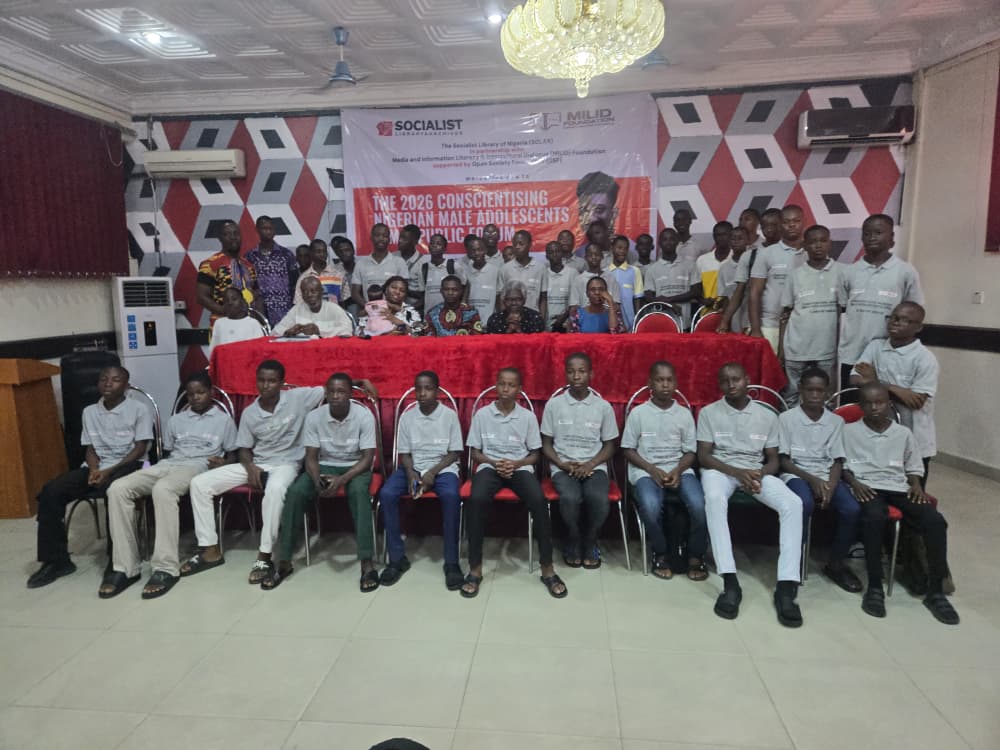
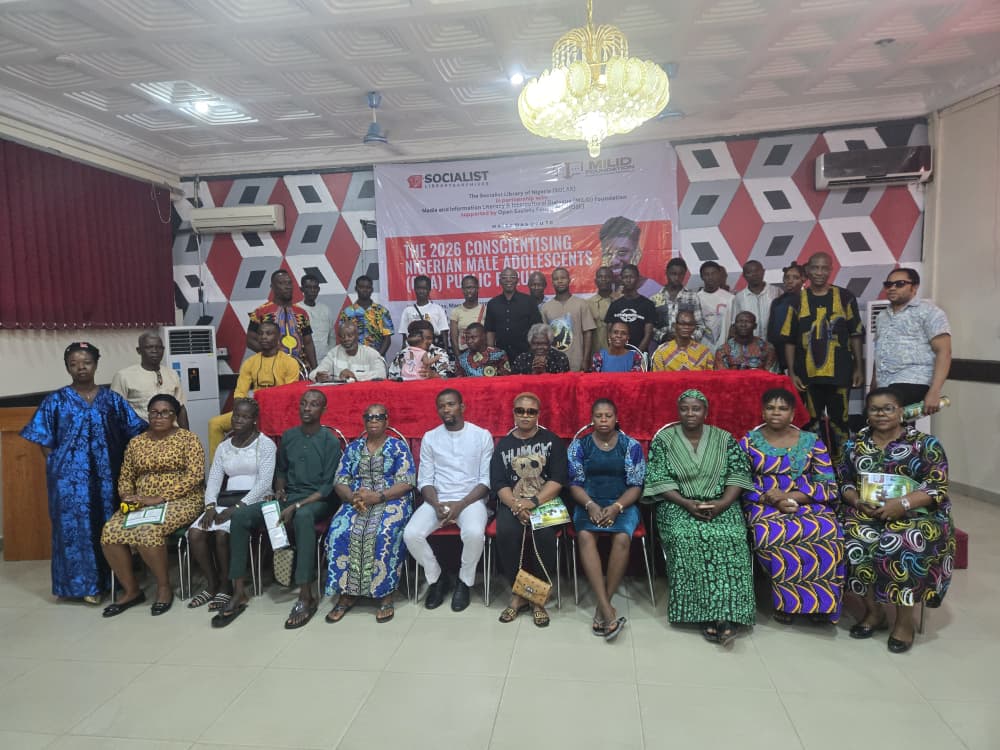
It was a fitting tribute, therefore, that the Socialist Library and Archives (SOLAR) Calabar, in partnership with MILID Foundation, would hold its Conscientizing Nigerian Male Adolescents (CMA) public forum for the class of 2025/26 on that day. The forum aimed at bringing together all current participants in the CMA programme, their parents/guardians, teachers as well as past CMA graduates to showcase the programme and its execution and make criticisms and suggestions on improvement.
The CMA project was developed out of a deep concern for the well-being and potential of our male adolescents and its impact on gender relations. It has consistently championed the values of equality, critical consciousness and responsible citizenship. For over three decades, it has proudly graduated more than 13,500 young men, each equipped with tools of anti-sexism, anti-patriarchy and critical consciousness to challenge the existing norms of our patriarchal society.
It is noteworthy that the week the CMA public forum held, reports surfaced of alleged rape and assault of young women during a festival in Ozoro community in Delta State. That sexual violence will so brazenly be perpetrated and celebrated in the 21st century is not only tragic but a pointer to how much work the Nigerian society needs to do to protect one half of its population. In this regard, the media has a very important role just as media and information literacy (MIL) is a vital tool.
Back to the CMA forum. The occasion also provided an opportunity to honour another remarkable revolutionary intellectual, Comrade Biodun Jeyifo or Comrade BJ, who died on February 11, 2026, but whose life continues to inspire struggle and hope. As members of the Board of Advisers of the Socialist Library and Archives (SOLAR), both Bene and BJ helped build a space where the ideas, history, and memory of progressive struggles could live on. These brilliant scholars, committed public intellectuals and revolutionaries remained faithful to the ideals of socialist transformation and reminded us that scholarship must not be neutral in the face of injustice. Knowledge must serve liberation.
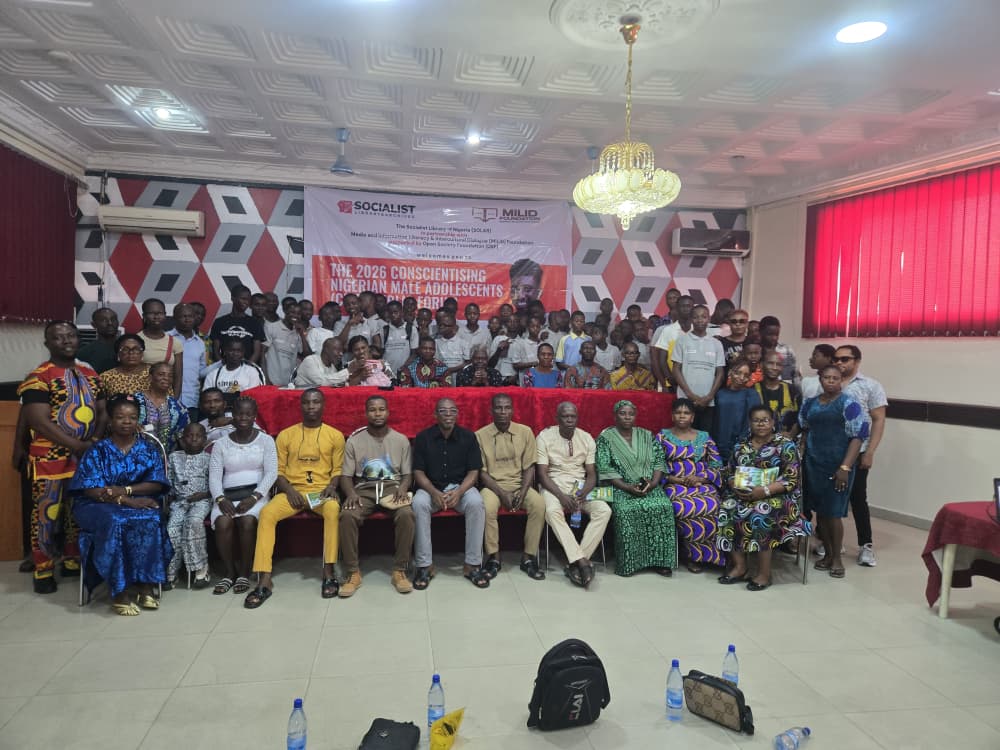
Together, they represent a tradition of intellectual courage and social commitment. They showed us that ideas are powerful—but only when they are used to challenge oppression and transform society. This is the spirit behind conscientization.
Conscientization is not simply education. It is the awakening of critical consciousness. It is the process through which people learn to see clearly the contradictions in society—the systems of domination that appear normal but are deeply unjust. Once people see these realities, they are empowered to act to change them.
In our society today, these contradictions are everywhere. We see them in the Ozoro tragedy. We see them in sexism and patriarchy, in violations of fundamental human rights, and in social structures that deny women and young people control over their own bodies and future. We see them in the lack of adequate medical services, the absence of reliable information on sexual and reproductive rights, and the persistence of harmful cultural practices.
At the same time, our society struggles with unemployment, poverty, drug addiction, and violent crimes. These problems do not exist in isolation—they are symptoms of deeper social and economic inequalities.
The CMA programme seeks to confront these realities through critical education. It addresses issues such as sexism, violence against women, cultural barriers to gender equality, and the historical roots of social injustice. Its goal is simple but powerful: to help young people think critically about society and their role in transforming it.
But conscientization must go beyond awareness. Awareness without action changes nothing.
The society we must struggle to build is one that rejects what Antonio Gramsci, Italian Marxist philosopher, linguist and politician, describes as internal colonialism – economic subordination and cultural subjugation through hegemony, ethnic domination, and class oppression. It must be a Nigeria where no religion dominates the state and where the freedom of thought, conscience, and belief is guaranteed for all. It must be a society that truly guarantees human rights and democratic freedom—not only in politics, but also in economic, social, and cultural life.
It must also be a society that refuses to tolerate violence against women and vulnerable groups. Gender-based violence, online and physical, sexual harassment, female genital mutilation, and other forms of inhuman and degrading practices must not be hidden behind culture or tradition. They must be confronted and eliminated.
And ultimately, it must be a society made up of educated, well-informed, and critically conscious citizens—people who refuse to accept injustice in any form as normal; one that ensures a safe, inclusive, and empowering digital environment where citizens, particularly women and marginalized groups, can function without fear of harassment or discrimination.
Of course, the lives of Comrade Bene Madunagu and Comrade Biodun Jeyifo remind us that this struggle is both intellectual and practical. It requires courage, clarity, and commitment. We must, therefore, continue the work they dedicated their lives to—the work of educating, organizing, and challenging every form of oppression.
In the last 30 years, CMA has proudly graduated over 13,500 young men, each equipped with tools of anti-sexism and critical consciousness to challenge the existing norms of our patriarchal society. The objective is to raise anti-sexist and critical consciousness in growing number of male adolescents and young boys. A consciousness that is capable of becoming a strategic weapon in mass anti-sexist and anti-patriarchal campaign linked to the struggle for humanization and democratization of Nigeria.
SOLAR adopts conscientization because to conscientize is to teach in such a way that the learner is assisted, gradually, through dialogue, not dictation, to perceive the contradictions and oppressive elements of our social reality. It defines a Nigerian male adolescent as a Nigerian, who is a male and who is roughly between the ages of 14 and 20 years. To be anti-sexist is to drop all prejudices against women, and to be critical is to question information and reality rather than bowing before them.
The link which SOLAR sees between anti-sexism and critical consciousness and which it is developing in Nigerian male adolescents through the CMA programme comes from the conviction that if a man’s consciousness is sufficiently critical, it will be easier to purge him of sexism, because sexism itself is an extreme form of uncritical consciousness.
It is our view that all the issues which are of concern to adolescent girls, including reproductive health and rights, sexual health and rights, fundamental human rights, including those rights specific to women, ignorance, poverty, powerlessness and alienation, exploitation and oppression, violence and indignity, are and should, be of concern to adolescent males and their elders. More generally, we hold that educating men on issues of specific concern and interest to women is an important, even critical, contribution to the universal struggle against the discrimination and injustices suffered by women and perpetrated mainly by men (or in the interest of men) both in private and in public life.
SOLAR’s position is that there is a lot of injustice in the institution known as family. Because both culture and law hypocritically designate the family as a private sphere, not only is this injustice under-reported and largely unaddressed, many perpetrators of domestic and private injustice often pose as defenders of freedom and democracy in the public. Children and adolescents are prime victims of, and sometimes accomplices in, the injustices perpetrated in the family: exploitation, oppression, discrimination, slavery, dehumanization and violence. The CMA programme aims at educating and assisting Nigerian male adolescents to become conscious of this.
Clearly, all talk about democracy, human rights and universal justice is hollow and unrealizable if injustices specific to one-half of humanity are either ignored or underplayed. In articulating anti-sexist education for the menfolk, the adolescents stand out. For it is during this period – when the male is growing into manhood and is very impressionable – that he absorbs the most backward social prejudices against women. We therefore target the adolescent male.
We believe this is where the future of society lies because a better and equitable society will not appear by chance. It must be imagined, fought for, and built by conscious people.
This essay was extracted from presentations at the public forum on Conscientizing Nigerian Male Adolescents organized by the Socialist Library and Archives (SOLAR), and MILID Foundation, in Calabar, Cross River State, on Saturday, March 21, 2026.